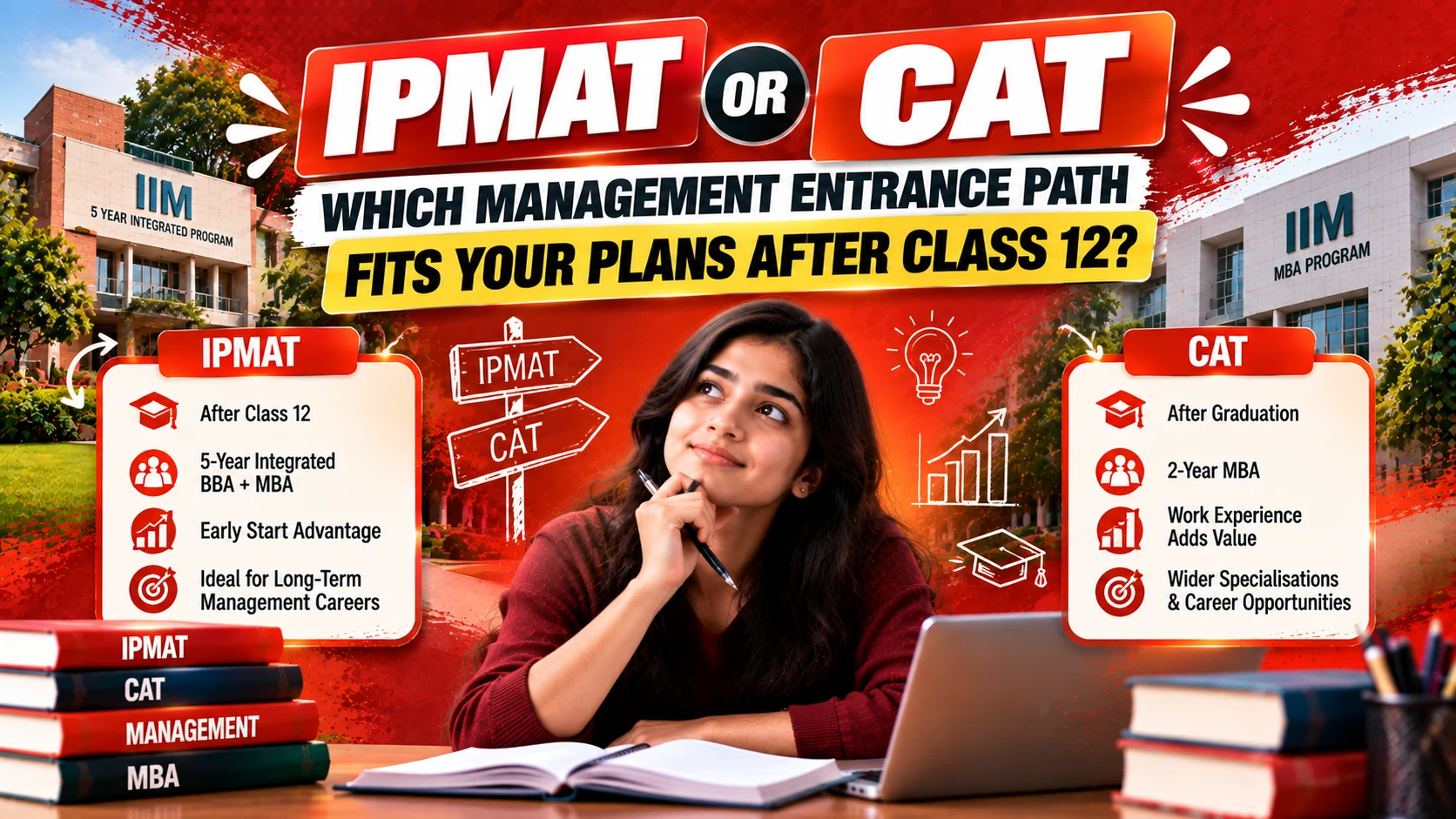
IPMAT or CAT: Which Management Entrance Path Fits Your Plans After Class 12?
IPMAT or CAT: Which Management Entrance Path Fits Your Plans After Class 12?
If you are interested in management as a career, you may already know about two major entrance routes connected with the Indian Institutes of Management (IIMs): IPMAT and CAT.
But there is an important difference students often overlook.
IPMAT can begin your management journey soon after Class 12, while CAT is primarily a postgraduate management entrance route that students generally take during or after completing a bachelor’s degree.
So, choosing between IPMAT and CAT is not simply about deciding which examination is easier. It is about deciding when you want to pursue management education, how certain you are about your career direction, and what kind of undergraduate experience you want first.
This guide breaks down the differences so that Class 11 and 12 students can understand which route better aligns with their plans.
What Is the Main Difference Between IPMAT and CAT?
IPMAT and CAT operate at different stages of a student’s academic journey.
IPMAT is associated with admission to Integrated Programme in Management routes offered after Class 12 by participating institutions. These programmes combine undergraduate and postgraduate stages of management education.
CAT, on the other hand, is primarily used for admission to postgraduate management programmes such as an MBA or equivalent programmes. Students normally become eligible for this route after progressing through an undergraduate degree.
In simple terms:
IPMAT route:
Class 12 → Entrance process → Integrated management programme
CAT route:
Class 12 → Bachelor’s degree → CAT → Postgraduate management programme
Neither pathway is automatically better. They simply represent different timelines for entering management education.
IPMAT vs CAT: Quick Comparison
| Factor | IPMAT Route | CAT Route |
|---|---|---|
| When does the journey begin? | After Class 12 | During/after graduation for postgraduate admission |
| Academic stage | Undergraduate-entry management route | Postgraduate-entry management route |
| Typical candidate | School student | College student/graduate |
| Main purpose | Admission to integrated management programmes | Admission to postgraduate management programmes |
| Preparation stage | Usually Classes 11–12 or after boards | Usually during college or after graduation |
| Career decision | Management chosen relatively early | Decision can be made after undergraduate study |
| Undergraduate flexibility | More structured toward management | Student can first pursue another bachelor’s discipline |
The exact eligibility criteria, test structure and admission process can change, so students should always verify the current admission notification of the institution they plan to apply to.
Who Should Consider the IPMAT Route After Class 12?
IPMAT may be worth exploring if you already have a meaningful interest in business, management, entrepreneurship, economics, leadership or related fields.
It can be particularly relevant if you:
- want to explore management education immediately after school;
- are comfortable making an early academic commitment;
- are interested in an integrated programme structure;
- enjoy aptitude-based subjects;
- and have researched the institutions and programmes available through this route.
However, being interested in an IIM name alone should not determine the decision.
Before choosing an integrated management programme, understand its curriculum, duration, fees, admission requirements, academic structure and career possibilities.
Who May Prefer the CAT Route?
The CAT route may suit students who do not want to commit to management immediately after Class 12.
For example, you might want to first pursue:
- engineering;
- commerce;
- economics;
- computer science;
- humanities;
- law;
- or another undergraduate discipline.
During those years, your career interests may become clearer.
You can then decide whether postgraduate management education fits your goals.
This route gives students additional time to explore an academic field before deciding whether an MBA or another postgraduate management programme is the right next step.
Is IPMAT an Alternative to CAT?
Not exactly.
It is more accurate to think of IPMAT and CAT as two different entry points into management education.
A Class 12 student exploring an integrated management programme is making a different academic decision from a graduate applying for an MBA.
That distinction matters because searching only for “IPMAT vs CAT” can make the two examinations appear more directly interchangeable than they actually are.
The better question is:
Do I want to begin a management-focused academic path after Class 12, or would I rather complete a separate undergraduate degree before considering postgraduate management education?
Does Choosing IPMAT Mean You Never Need CAT?
Not necessarily.
Your future options depend on the programme you join, its rules and the choices you make later.
Joining an integrated programme does not mean every academic or career decision for the next several years is permanently fixed.
Similarly, deciding not to pursue IPMAT after Class 12 does not close the door to management education. You can complete an undergraduate degree and later explore CAT or other management entrance examinations.
Students should therefore think of these routes as different pathways rather than irreversible choices.
How Different Is the Preparation for IPMAT and CAT?
Both examinations involve aptitude-based skills, but students should not assume that preparing for one is identical to preparing for the other.
Quantitative Ability
Both pathways can require strong quantitative aptitude, but the level, syllabus emphasis and question style can differ.
For IPMAT aspirants coming directly from school, building comfort with arithmetic, algebra and other relevant quantitative concepts is important.
CAT aspirants usually prepare after gaining several additional years of academic experience.
Verbal Ability
Reading comprehension, vocabulary, grammar and reasoning with written information can play an important role in management entrance preparation.
Developing a regular reading habit during Classes 11 and 12 can therefore be useful beyond a single entrance examination.
Logical and Analytical Thinking
Management entrance examinations often reward the ability to interpret information, recognize patterns and make decisions under time pressure.
These skills generally improve through consistent practice rather than memorization.
Should You Choose IPMAT Just Because You Want to Study at an IIM?
That should not be the only reason.
The institution matters, but so does the programme itself.
Before applying, research:
- subjects taught throughout the programme;
- academic workload;
- programme duration;
- total cost;
- campus environment;
- internship opportunities;
- programme-specific rules;
- and the career directions graduates commonly pursue.
Your goal should be to choose an academic pathway that fits your interests rather than selecting a programme based only on a brand name.
What If You Are Not Sure About Management Yet?
Being uncertain in Class 12 is completely normal.
You do not need to force yourself into a management programme simply because you are eligible for an entrance examination.
Ask yourself:
Do I actually enjoy business and management-related subjects?
Am I comfortable choosing a management-oriented programme now?
Would I prefer exploring another undergraduate field first?
What kind of careers am I curious about?
Am I choosing this route because it fits me, or because everyone around me is recommending it?
Researching these questions can be more useful than trying to determine which entrance exam sounds more prestigious.
Can Science Students Apply for IPMAT?
Students sometimes assume management entrance examinations are mainly for commerce students.
That is not necessarily the case.
Students from different Class 12 academic backgrounds may be able to apply, subject to the eligibility requirements of the particular institution and admission year.
A science student may already be comfortable with quantitative problem-solving, while commerce or humanities students may bring strengths in other areas.
Your school stream alone should therefore not determine whether you explore management.
Always check the current eligibility notification of the institution you are targeting.
Can Commerce Students Handle IPMAT Quantitative Ability?
Yes, but preparation requirements vary from student to student.
Students without advanced mathematics may need additional time to strengthen quantitative fundamentals. That does not automatically make the exam unsuitable for them.
Instead of focusing only on your stream, evaluate your current ability in:
- arithmetic;
- algebra;
- numerical reasoning;
- reading comprehension;
- vocabulary;
- logical thinking;
- and timed problem-solving.
A diagnostic test can help identify where you actually need improvement.
Should You Prepare for IPMAT During Class 11 or Wait Until Class 12?
Starting early can reduce pressure, but early preparation does not mean spending several hours every day on entrance preparation from Class 11.
Students can initially concentrate on fundamentals such as:
- quantitative concepts;
- vocabulary;
- reading;
- mental calculations;
- reasoning;
- and problem-solving speed.
As the examination approaches, preparation can gradually shift toward sectional tests, timed practice and full-length mocks.
Your school academics should remain an important part of the overall plan.
What If You Don’t Clear IPMAT?
IPMAT should not be treated as the only possible route to a management career.
If you do not secure admission through the route you originally targeted, you can still pursue an undergraduate degree and consider management education later.
Depending on your interests, you may explore degrees such as BBA, BCom, economics, engineering or other disciplines and subsequently decide whether CAT or another postgraduate entrance route makes sense.
Having alternative plans can also reduce unnecessary pressure during entrance preparation.
IPMAT or CAT: How Should You Decide?
Instead of asking which exam is “better,” ask which timeline suits you.
Consider exploring IPMAT if:
- you are currently in school;
- management already interests you;
- you want to begin a management-oriented programme after Class 12;
- you are comfortable with an integrated academic structure;
- and you have researched the relevant programmes carefully.
Consider the later CAT route if:
- you want to study another subject at undergraduate level first;
- you are uncertain about management as a long-term direction;
- you want more time before deciding on postgraduate management education;
- or you prefer keeping your undergraduate options broader.
The decision should reflect your academic interests and long-term plans rather than comparisons with friends or classmates.
A Simple Decision Framework for Class 12 Students
Still confused? Use these three questions.
1. Am I reasonably sure about management?
If yes, research IPMAT-linked programmes in greater detail.
If not, explore undergraduate programmes before committing to a specific management path.
2. Do I want management education immediately after Class 12?
If yes, the integrated programme route may be relevant.
If you prefer completing another bachelor’s degree first, CAT becomes a potential later-stage pathway.
3. Have I researched the programme rather than only the entrance exam?
Entrance tests last a few hours.
The academic programme lasts several years.
Spend more time researching the programme than comparing entrance-test difficulty.
Final Thoughts: Choose the Path, Not Just the Exam
The biggest difference between IPMAT and CAT is not simply their difficulty.
It is when they enter your academic journey.
IPMAT gives eligible students an opportunity to explore an integrated management pathway after Class 12. CAT is generally relevant later, when students are pursuing or have completed an undergraduate degree and want to compete for postgraduate management programmes.
If you already have a strong interest in management, exploring IPMAT can help you understand whether an integrated programme suits you.
If you are still discovering your interests, completing an undergraduate degree before making the management decision can also be a valid path.
Don’t choose based only on which exam appears easier, which route your friends are taking or which institution name sounds more attractive.
Choose based on what you want to study, when you want to specialize and where you want your academic journey to take you.
IPMAT Preparation Batches
Students who have decided to explore the IPMAT route can build their preparation around concept development, aptitude practice, timed tests and regular performance analysis.
IPMAT 2028 COMPREHENSIVE COURSE
✓ 500+ Hours of Classroom Training
✓ 95+ Full Length Mock Tests
✓ 11+ Books of Study Materials(Printed)
✓ Course Valid till June 2028
IPMAT 2027 EXTENSIVE CLASSROOM
✓ 300+ Hours of Classroom Training
✓ 80+ Full Length Mock Tests
✓ 11+ Books of Study Materials(Printed)
✓ Course Valid till June 2027