
Accuracy or Attempts: What Matters More in IPMAT?
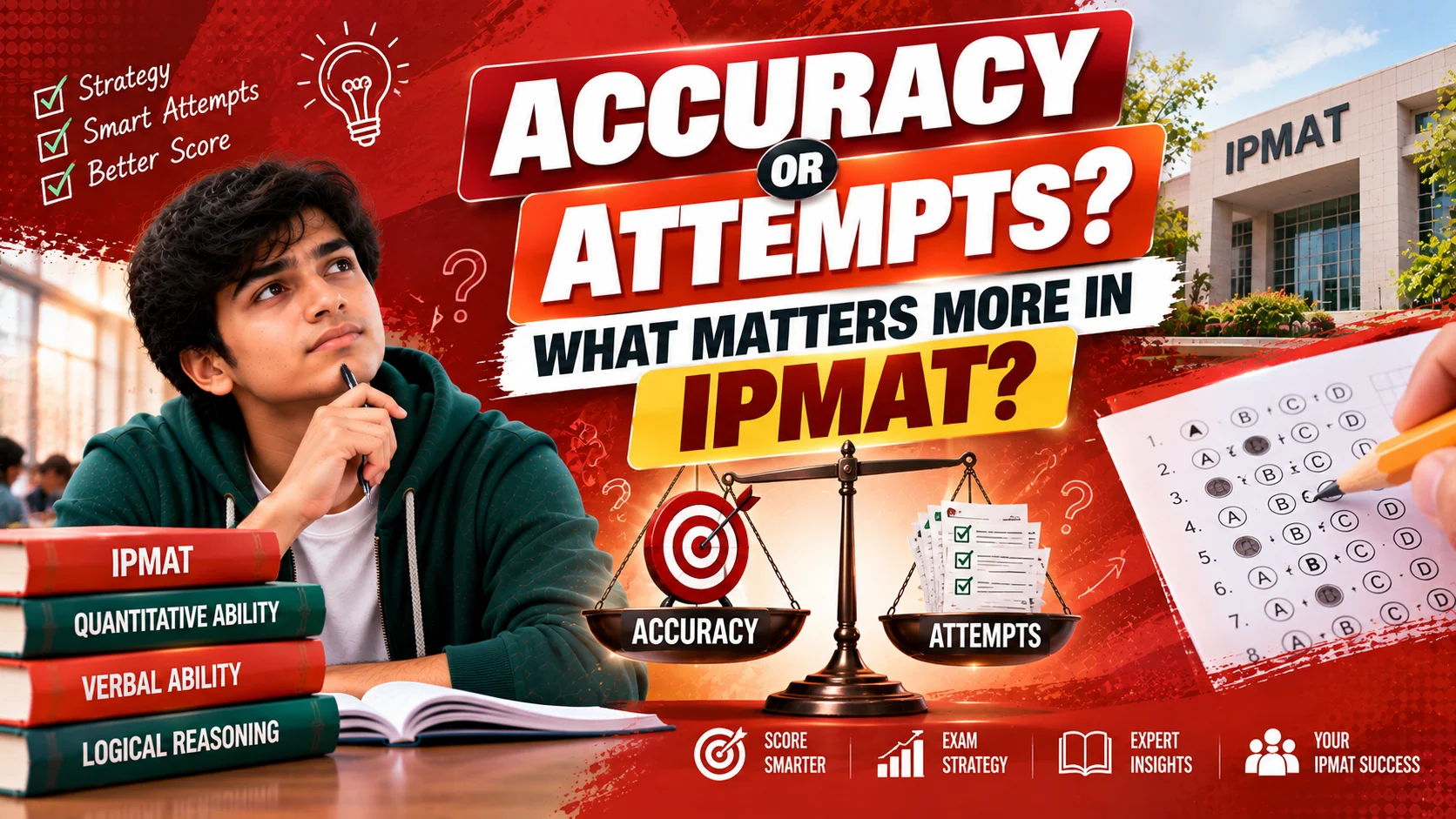
Accuracy or Attempts: What Matters More in IPMAT?
When preparing for IPMAT, students often face the same question: Should I try to attempt as many questions as possible, or should I focus on getting fewer questions right?
The answer is not simply “accuracy” or “attempts.” A strong IPMAT strategy requires a balance between the two.
Attempt too few questions, and you may leave potential marks behind. Attempt too many without being sure, and negative marking can reduce the advantage you gained from the extra attempts.
The better approach is to maximize your score rather than maximize your number of attempts.
This article explains how accuracy, attempts, negative marking, question selection, and mock-test analysis should work together while preparing for IPMAT.
Why Accuracy and Attempts Both Matter in IPMAT
Your final score is influenced not only by how many questions you attempt but also by how many of those attempts are correct.
For IPMAT Indore 2026, the aptitude test had three sections:
- Quantitative Ability (MCQ)
- Quantitative Ability (Short Answer)
- Verbal Ability (MCQ)
Each question carried four marks. Wrong answers in the MCQ sections attracted a one-mark penalty, while the Quantitative Ability Short Answer section did not have negative marking.
This makes question selection particularly important.
Consider two students.
Student A attempts a large number of questions but makes several avoidable mistakes.
Student B attempts slightly fewer questions but gets a much higher percentage correct.
The student with more attempts does not automatically finish with the better score. What matters is the net score generated from those attempts.
So, What Matters More: Accuracy or Attempts?
Accuracy should come first, but accuracy alone is not enough.
A student who maintains excellent accuracy but attempts very few questions may struggle to generate a competitive score. On the other hand, attempting almost every question without sufficient confidence can expose the student to unnecessary negative marks.
Think of it this way:
Accuracy protects your score. Attempts create opportunities to increase it.
The goal is therefore not:
“How many questions can I attempt?”
Instead, ask:
“How many questions can I answer confidently while maintaining good accuracy?”
That small change in thinking can make a major difference to your test-taking strategy.
Why Blind Attempts Can Hurt Your IPMAT Score
Suppose you see a difficult MCQ and cannot eliminate any options.
Attempting it only because you want to increase your attempt count is usually not a sound strategy.
For the 2026 IIM Indore test pattern, a correct MCQ earned four marks while an incorrect MCQ resulted in a one-mark deduction.
Therefore, your decision should depend on what you know about the question.
There is an important difference between:
Calculated attempt
You understand the question, solve most of it or confidently eliminate options.
Blind attempt
You have little idea about the answer and choose an option mainly because you do not want to leave the question unanswered.
Increasing calculated attempts is useful. Increasing blind attempts is not a reliable way to improve your score.
Why Attempting Too Few Questions Can Also Be a Problem
Some students become so worried about negative marking that they move to the opposite extreme.
They attempt only questions about which they are completely certain.
That can also restrict their score.
Entrance examinations test not only knowledge but also decision-making under time pressure. You will not necessarily feel 100% certain about every question that is worth attempting.
You therefore need to learn the difference between:
- a question you genuinely do not know;
- A question that requires a bit more time to work through;
- a question where you can narrow down the possibilities;
- and a question you can solve confidently.
That judgment improves through practice rather than memorizing a fixed “ideal number of attempts.”
There Is No Universal Safe Number of Attempts
Students frequently search for questions such as:
“How many questions should I attempt in IPMAT?”
There is no single number that is safe for every student or every paper.
The appropriate number can depend on:
- difficulty of the paper;
- difficulty of individual sections;
- your strengths and weaknesses;
- your accuracy level;
- time available;
- and the questions presented in that particular exam.
Following a fixed target like “I have to attempt X questions no matter what” may not always be effective.
Instead of setting a rigid attempt target, build an attempt range through mock-test data.
Your own performance history is much more useful than somebody else’s attempt count.
Sectional Performance Matters Too
IPMAT Indore should not be approached as though only the overall number of attempts matters.
The official 2026 admissions data shows that sectional cut-offs were used when identifying candidates for subsequent score calculations and shortlisting. The cut-offs varied by section and applicant category.
That means completely sacrificing one section simply to maximize attempts in another is not a sensible strategy.
Your preparation should aim for sufficient competence across the required sections while building stronger scoring opportunities in your better areas.
A Better Way to Choose Questions During IPMAT
Instead of treating every question equally, mentally divide them into three categories.
1. High-Confidence Questions
These are questions where you:
- understand the concept immediately;
- know the method;
- can solve them within a reasonable time;
- and are confident about the answer.
These should normally receive priority.
2. Medium-Confidence Questions
These may require additional calculation, elimination or a second look.
Attempting them can be worthwhile, but you need to control how much time you spend on them.
3. Low-Confidence Questions
These are questions where:
- the concept is unfamiliar;
- you cannot identify a clear approach;
- calculations are becoming excessively long;
- or you are effectively guessing.
Knowing when to leave such a question can be just as valuable as knowing how to solve another one.
The objective is to spend your limited exam time where it has the highest potential return.
Accuracy vs Attempts in Quantitative Ability
Quantitative Ability often creates a unique problem.
Students may understand how to solve a question but spend too much time completing the calculation.
This makes question selection and time management especially important.
If a question looks unusually lengthy, leaving it temporarily does not mean you cannot solve it. It means you are protecting time for questions that may produce marks more efficiently.
During preparation, track:
- questions solved correctly;
- questions solved incorrectly;
- questions left because of time;
- questions left because of conceptual weakness;
- and questions where calculation errors occurred.
This tells you far more than simply recording your mock score.
Accuracy vs Attempts in Verbal Ability
In Verbal Ability, over-attempting can happen for a different reason.
Students may feel that two answer choices “look almost correct” and select one without properly checking the context.
Instead, work on identifying why an option is correct and why competing options are incorrect.
For reading-based questions, avoid choosing an answer simply because it sounds reasonable. The answer should be supported by the information or reasoning required by the question.
Vocabulary, grammar and reading comprehension practice can gradually improve both speed and confidence, allowing your number of quality attempts to increase naturally.
How Mock Tests Help You Find Your Ideal Attempt Strategy
Mock tests should not be used only to check your score or rank.
They are one of the best ways to understand your personal relationship between attempts, accuracy and marks.
After every mock, record:
| Metric | What to Track |
|---|---|
| Total Attempts | Number of questions attempted |
| Correct Answers | Questions answered correctly |
| Incorrect Answers | Questions answered incorrectly |
| Accuracy | Correct answers compared with total attempts |
| Unattempted Questions | Questions you skipped |
| Time Errors | Questions you knew but could not complete |
| Concept Errors | Questions missed because the concept was unclear |
| Careless Errors | Calculation, reading or marking mistakes |
After several mocks, patterns will begin to appear.
For example, you may notice that increasing your attempts slightly improves your score without significantly reducing accuracy.
Or you may discover that your score drops whenever you become too aggressive during the final few minutes.
That evidence should shape your exam strategy.
Don’t Chase 100% Accuracy
Aiming for better accuracy is useful.
Expecting perfect accuracy in every mock is usually unrealistic.
If fear of making a mistake prevents you from attempting questions you are capable of solving, the pursuit of accuracy itself becomes a limitation.
Your goal should be controlled risk, not zero risk.
As your preparation improves, you should ideally become capable of attempting more questions while maintaining reasonable accuracy.
That is a much stronger sign of progress than accuracy percentage alone.
How to Improve Accuracy Without Becoming Too Slow
Accuracy does not have to come at the cost of speed.
Try these habits during practice:
- Read the complete question before solving. Many avoidable mistakes come from missing a condition or keyword.
- Do not repeatedly recalculate easy questions. Build confidence through practice so that unnecessary verification does not consume time.
- Identify your recurring errors. Maintain an error log for calculation mistakes, misunderstood concepts and incorrect assumptions.
- Practice under timed conditions. Untimed accuracy does not fully reflect performance in an actual entrance examination.
- Review incorrect answers carefully. Understanding why you made a mistake is more valuable than simply checking the correct answer.
- Learn when to move on. Spending several minutes on one difficult problem can reduce your opportunity to solve multiple easier ones.
What Should You Focus on During Different Stages of Preparation?
Your balance between accuracy and attempts can change as your preparation progresses.
Early Preparation: Build Accuracy
Initially, focus on understanding concepts and developing correct solving methods.
There is little value in becoming faster at an incorrect method.
Middle Stage: Improve Speed
Once your concepts become stronger, introduce timed sectional practice.
The objective is to solve familiar question types faster without significantly reducing accuracy.
Mock-Test Stage: Optimize Attempts
Full-length mocks help you determine how aggressively you should attempt the paper.
Experiment carefully with different strategies and compare the resulting scores.
Final Stage: Stabilize Your Strategy
Close to the exam, avoid changing your entire strategy because another student reports a higher attempt count.
Trust the approach supported by your own mock-test performance.
A Simple Rule to Remember
When deciding whether to attempt a question, ask yourself three things:
Do I understand the question?
Do I have a clear way to solve it?
Is the time required reasonable compared with the marks available?
If the answer to these questions is mostly yes, the question deserves your attention.
If you are completely unsure and are only trying to increase your attempt count, moving forward may be the better decision.
Final Takeaway: Quality Attempts Matter More Than Maximum Attempts
So, accuracy or attempts: what matters more in IPMAT?
Neither should be viewed in isolation.
Accuracy without enough attempts can limit your scoring potential, while a high number of careless attempts can expose you to unnecessary negative marks.
The better objective is to increase your quality attempts — questions you can solve with sufficient confidence, within an appropriate amount of time.
Use mock tests to discover your personal balance. Track why you lose marks, improve your weaker areas and gradually increase the number of questions you can attempt without allowing accuracy to collapse.
By exam day, you should not be thinking, “I need to attempt as many questions as possible.”
You should be thinking:
“I need to make every attempt count.”
IPMAT Preparation Batches
If you want structured preparation, regular practice and performance analysis, explore the current IIMPrep IPMAT batches.
IPMAT 2028 COMPREHENSIVE COURSE
✓ 500+ Hours of Classroom Training
✓ 95+ Full Length Mock Tests
✓ 11+ Books of Study Materials(Printed)
✓ Course Valid till June 2028

IPMAT 2027 EXTENSIVE CLASSROOM
✓ 300+ Hours of Classroom Training
✓ 80+ Full Length Mock Tests
✓ 11+ Books of Study Materials(Printed)
✓ Course Valid till June 2027