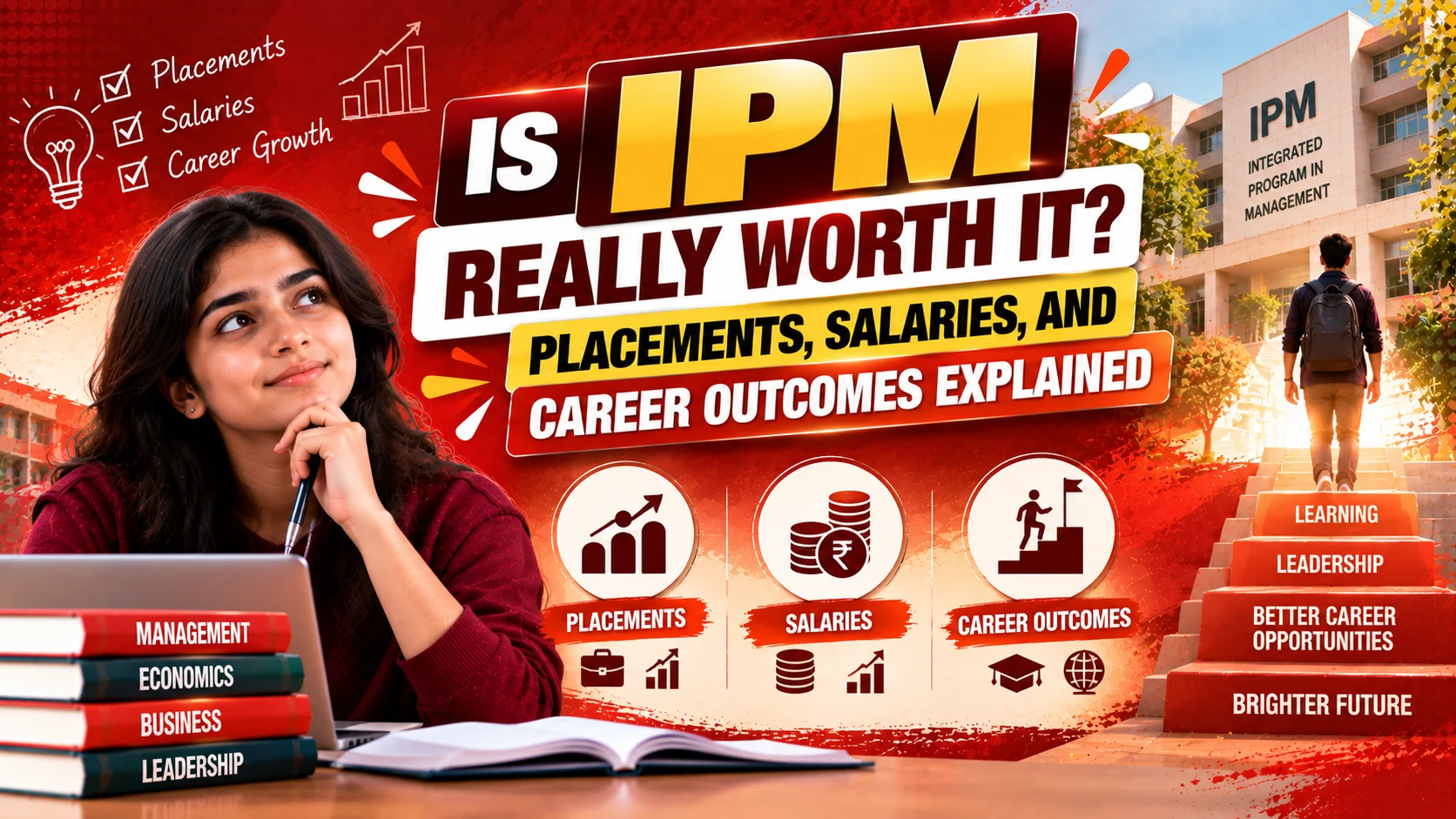
Is IPM Really Worth It? Placements, Salaries, and Career Outcomes Explained
Is IPM Really Worth It? Placements, Salaries, and Career Outcomes Explained
A five-year management programme is a significant commitment to make immediately after school. That is why students exploring IPM often look beyond entrance requirements and ask a more practical question:
What will I actually gain from choosing IPM after Class 12?
Placement figures are usually the first thing students notice. But a large salary number on a placement page cannot tell you whether a programme is suitable for you.
The real value of an Integrated Programme in Management depends on several things: what you learn, how much the programme costs, the exposure you receive, the skills you develop and the opportunities available when you graduate.
So, instead of judging IPM from one placement statistic, let’s examine what students should actually consider before making the decision.
First, Understand What You Are Signing Up For
IPM is not simply an MBA that starts early.
It is a multi-year academic journey that begins after Class 12 and gradually introduces students to different areas of learning before moving deeper into management education.
Depending on the institute, students may encounter subjects related to mathematics, economics, statistics, communication, social sciences and business before progressing into more specialized management areas.
This multidisciplinary structure is one reason some students find IPM attractive.
However, programmes differ across institutions. Curriculum, fees, degree structure, academic requirements and progression rules should therefore be checked individually.
Don’t choose an IPM simply because another institute’s programme looks attractive. Research the exact programme you intend to join.
Why Do Students Consider IPM After Class 12?
For many students, the biggest attraction is timing.
A student who already sees management as a possible career direction does not necessarily have to wait until graduation to begin exploring the field.
Starting earlier can provide more time to understand areas such as:
- business decision-making;
- economics;
- finance;
- marketing;
- communication;
- analytics;
- strategy;
- organizational behaviour;
- and entrepreneurship.
But an early start is valuable only when it matches your interests.
If you are still strongly interested in engineering, law, economics, design, technology or another undergraduate discipline, you should compare those routes before committing yourself to an integrated management programme.
What Can You Actually Do After an IPM?
One common misconception is that management education leads to one specific type of job.
In reality, career directions can vary considerably.
A student’s eventual opportunities depend on the institute, skills developed during the programme, internships, specialization choices, recruiter requirements and individual performance.
Here are some areas management graduates may explore.
Consulting and Business Problem-Solving
Students who enjoy analysing situations, working with information and breaking large problems into smaller ones may be interested in consulting or business advisory roles.
These careers can require strong reasoning, presentation and communication abilities.
Finance and Financial Analysis
Students interested in numbers, businesses and financial decision-making may explore finance-related opportunities.
The actual roles available depend on the student’s profile and the companies recruiting from the institution.
Marketing and Brand Roles
Marketing is broader than advertising.
Career opportunities can involve customer research, brand strategy, sales, digital marketing, product positioning and market analysis.
Students who enjoy understanding why customers make decisions may find this direction interesting.
Product, Strategy and Business Roles
Technology-driven businesses have also increased interest in roles that combine customer understanding, data, business strategy and product development.
Students interested in both business and technology may eventually explore such opportunities.
Operations
Businesses need people who can improve how work gets done.
Operations-related careers can involve processes, supply chains, planning, logistics and efficiency.
Entrepreneurship
Some students may decide to build something of their own rather than immediately joining an established organization.
Management education can provide exposure to areas such as finance, markets, customers and business models.
It does not guarantee entrepreneurial success, but it can help students understand how different parts of a business connect.
What Do IPM Placement Numbers Actually Tell You?
This is where students need to read carefully.
Search for IPM placements online and you may see figures for highest salary, average salary or major recruiters.
Those numbers can be useful, but only when you understand what they represent.
A placement report belongs to a particular graduating group in a particular year. It reflects the recruiters, economic environment and employment market affecting that batch.
It should not be interpreted as a promise of what every future student will earn.
Before using placement numbers to compare institutes, ask:
Which batch does this data represent?
Which students were included in the placement process?
Is the number an average, median or highest package?
What kinds of roles were offered?
Which industries recruited students?
This gives you a much more meaningful picture than looking only at the largest number on the page.
Highest Package Doesn’t Mean Typical Package
Suppose an institute reports one exceptionally large compensation package.
That result is significant for the student who received it, but it doesn’t automatically describe the experience of the entire batch.
This is why students should understand three different figures.
Highest Package
This is the largest reported compensation in the relevant placement cycle.
It shows the upper end of the reported offers but should not become your personal salary expectation.
Average Package
The average combines the compensation figures included in the placement data and calculates their mean.
It provides useful context, although a small number of unusually large packages can influence it.
Median Package
The median represents the middle of the reported salary distribution.
When available, looking at the median alongside the average can provide additional perspective on the placement outcome.
Instead of asking only, “What is the highest IPM package?”, ask:
“What does the overall placement profile look like?”
That is a much better research question.
Will Joining an IPM Guarantee Me a Good Job?
No programme can make that guarantee.
An institute can provide education, recruiters, networks and opportunities. What a student does with those opportunities still matters.
Two students graduating from the same programme can have very different outcomes.
Factors that can influence recruitment include:
- academic record;
- internships;
- communication;
- analytical ability;
- problem-solving;
- project experience;
- interview preparation;
- leadership experience;
- specialization;
- and the hiring environment at the time of graduation.
This is why focusing only on getting admission can be shortsighted.
Admission gets you into the programme.
What you build during those years influences what you can do after it.
The Skills You Build May Matter More Than You Expect
A five-year programme gives students considerable time to develop abilities beyond examinations.
For example, a student interested in analytics can gradually strengthen statistics, spreadsheets and data interpretation.
Someone interested in marketing can participate in campaigns, competitions, research projects and internships.
A student interested in entrepreneurship can experiment with ideas, work with student communities and learn how businesses operate.
Over several years, these experiences can shape your profile.
Useful skills may include:
- presenting ideas clearly;
- interpreting data;
- writing professionally;
- working in teams;
- solving unfamiliar problems;
- understanding basic financial concepts;
- using relevant digital tools;
- and managing projects.
Your degree opens doors. Your capabilities influence what happens when those doors open.
Internships Can Help You Test Your Career Assumptions
At 17 or 18, it is difficult to know exactly what working in consulting, finance, marketing or product management actually feels like.
Internships can help close that gap.
You may enter an internship believing you want a particular career and discover that you enjoy another area more.
That is useful information.
Internships can help students understand workplace expectations, identify skill gaps and make more informed career decisions before final placements begin.
So when researching an IPM, don’t investigate placements alone.
Look at the broader ecosystem of internships, projects, competitions and practical exposure available to students.
Is a Five-Year IPM Expensive?
Cost deserves serious attention because IPM is a long academic commitment.
Instead of asking only about annual tuition, calculate what the entire journey may cost.
Your estimate may need to include:
- academic fees;
- hostel or accommodation expenses;
- food;
- learning materials;
- deposits;
- travel;
- personal expenses;
- and other institute-specific charges.
These amounts vary between institutions and admission years.
Use the latest official fee information when calculating your expected expenditure.
Once you have an approximate total, your family can evaluate affordability, available financial assistance and alternative education routes more realistically.
Does IPM Offer Good Return on Investment?
Students often try to calculate IPM ROI by comparing programme fees with placement salaries.
That calculation is useful, but incomplete.
Your first salary is only one part of the return you receive from education.
A broader evaluation can include:
Financial investment
How much will the entire programme cost?
Academic value
What will you actually learn?
Professional exposure
What internships, projects and industry interactions are available?
Career access
Which sectors and roles recruit from the institute?
Network
What kind of peer and alumni community will you become part of?
Long-term flexibility
Will the skills and education remain useful if your career interests change?
A programme can have strong placement statistics and still be unsuitable for a particular student.
ROI therefore needs to be considered personally, not just mathematically.
IPM or Bachelor’s Degree First: How Should You Think About It?
Students interested in management generally don’t have only one possible route.
One option is:
Class 12 → Integrated Management Programme → Career opportunities
Another is:
Class 12 → Bachelor’s Degree → Management entrance route → Postgraduate management programme
The first route introduces management earlier.
The second allows you to study another discipline at undergraduate level before deciding whether management should be your postgraduate direction.
For example, someone deeply interested in computer science may prefer studying technology first and considering management later.
Another student who is already fascinated by businesses, markets and organizational decision-making may find an integrated route more aligned with their interests.
The question isn’t which route sounds more impressive.
The question is which academic journey makes sense for you.
Don’t Choose IPM Only for the IIM Tag
An institute’s reputation naturally matters.
But it shouldn’t replace proper research.
Remember that you will spend years studying the curriculum, completing assignments, taking examinations and building your career.
Before applying, investigate:
- subjects taught;
- programme duration;
- fee structure;
- campus experience;
- internships;
- progression requirements;
- placement information;
- and career possibilities.
A well-known institution can provide opportunities, but the programme itself still needs to fit your interests and circumstances.
A Practical Checklist Before You Decide
Before concluding that IPM is worth the investment, try answering these questions.
Do I genuinely enjoy management-related subjects?
Interest matters when you are committing several years to a particular academic direction.
Have I looked at the actual curriculum?
Don’t judge the programme from its name.
Read what students study semester by semester where such information is available.
Can my family comfortably plan for the total cost?
Consider the entire programme rather than only the first year’s fee.
Have I studied official placement information?
Use institute-published reports where available instead of relying entirely on social-media posts or promotional claims.
Am I comfortable starting management education immediately?
If you strongly want to explore another discipline first, compare alternative undergraduate routes.
Am I expecting admission alone to guarantee a career?
Your performance throughout the programme remains important.
When Can IPM Be a Sensible Choice?
IPM may deserve serious consideration when a student has already developed an interest in management and wants a structured academic route beginning after Class 12.
It can also appeal to students who value multidisciplinary learning and want several years to develop business, analytical and communication skills.
However, that decision becomes stronger when it is based on research rather than salary expectations.
When Should You Explore Alternatives Too?
Keep other options open if you are still uncertain about your academic direction.
You may also want to compare alternatives if the programme’s financial commitment is difficult, you strongly prefer another undergraduate subject, or your main reason for choosing IPM is an advertised placement figure.
Exploring alternatives does not mean rejecting management as a future career.
You can still consider management education later after completing another undergraduate programme.
So, Is IPM Really Worth It?
For the right student, an Integrated Programme in Management can provide an early and structured introduction to management education.
But the value of the programme should not be reduced to a placement package.
A better way to evaluate it is to consider:
What will I study?
What will the full programme cost?
What opportunities will I have during those years?
What skills can I develop?
What careers could those skills lead toward?
Does that journey fit what I want after Class 12?
Placement statistics can help you evaluate an institute, but they cannot predict your individual future.
The value you receive from IPM will depend on both the opportunities the programme provides and how effectively you use them.
Research the programme carefully, compare alternatives and make the decision based on the complete academic and career picture not one salary headline.
Explore Current IIMPrep Batches
Deciding whether IPM suits you should come before choosing how to prepare for the entrance process.
If you have already evaluated the programme and want to pursue the IPM route, you can explore IIMPrep’s current preparation options based on your target year and learning requirements.
IPMAT 2028 COMPREHENSIVE COURSE
✓ 500+ Hours of Classroom Training
✓ 95+ Full Length Mock Tests
✓ 11+ Books of Study Materials(Printed)
✓ Course Valid till June 2028
IPMAT 2027 EXTENSIVE CLASSROOM
✓ 300+ Hours of Classroom Training
✓ 80+ Full Length Mock Tests
✓ 11+ Books of Study Materials(Printed)
✓ Course Valid till June 2027